
Adolpha Name Meaning & Details
Origin, Popularity, Numerology Analysis & Name Meaning of Adolpha
Discover the origin, meaning, and cultural significance of the name ADOLPHA. Delve into its historical roots and explore the lasting impact it has had on communities and traditions.
Name
Adolpha
Gender
Female
Origin
German
Lucky Number
3
Meaning of the Name - Adolpha
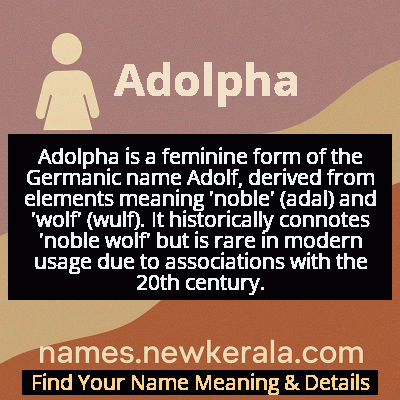
Adolpha is a feminine form of the Germanic name Adolf, derived from elements meaning 'noble' (adal) and 'wolf' (wulf). It historically connotes 'noble wolf' but is rare in modern usage due to associations with the 20th century.
Adolpha - Complete Numerology Analysis
Your Numerology Number
Based on Pythagorean Numerology System
Ruling Planet
Jupiter
Positive Nature
Optimistic, inspirational, and creative.
Negative Traits
Scattered, exaggerating.
Lucky Colours
Yellow, gold, purple.
Lucky Days
Thursday.
Lucky Stones
Yellow sapphire.
Harmony Numbers
1, 2, 9.
Best Suited Professions
Arts, writing, communication.
What People Like About You
Creativity, optimism.
Famous People Named Adolpha
Adolpha of Bavaria
Noblewoman
Member of the House of Wittelsbach, known for her charitable works and patronage of the arts
Adolpha Meyer
Educator
Pioneering women's education advocate in Germany, founded several girls' schools
Adolpha Schmidt
Botanist
Noted for her research on alpine flora and plant conservation efforts
Name Variations & International Equivalents
Click on blue names to explore their detailed meanings. Gray names with will be available soon.
Cultural & Historical Significance
The 19th century Romantic movement revived interest in such names as part of broader cultural nationalism across German-speaking regions. Adolpha represented a connection to authentic Germanic heritage at a time when national identities were being consciously constructed. The name's usage declined dramatically in the 20th century due to associations with Adolf Hitler, though scholarly interest in its original meaning has persisted. Today, the name represents a complex cultural artifact—simultaneously embodying ancient Germanic values and modern historical consciousness, making it a fascinating subject for cultural historians and onomastic researchers studying how names evolve in meaning across centuries.
Extended Personality Analysis
The personality traits associated with Adolpha reflect its etymological components of nobility and wolf-like qualities. Individuals with this name are often characterized by strong protective instincts, particularly toward family and community. They typically demonstrate natural leadership abilities combined with deep loyalty to those they consider part of their 'pack.' The noble aspect contributes to a sense of inherent dignity, ethical clarity, and commitment to principles that guide their actions. These individuals often possess strategic thinking abilities and resilience in facing challenges.
In social contexts, Adolphas are frequently perceived as authoritative yet caring figures who balance strength with compassion. They tend to be decisive in crisis situations while maintaining thoughtful consideration of others' wellbeing. The wolf symbolism suggests someone who values family bonds intensely, demonstrates fierce loyalty, and possesses strong survival instincts. These traits often manifest as career success in fields requiring both leadership and protective qualities, such as education, healthcare, community organizing, or environmental conservation. The combination of noble bearing and protective nature creates a personality archetype that commands respect while inspiring trust and devotion in personal and professional relationships.
Modern Usage & Popularity
In contemporary naming practices, Adolpha exists as an extremely rare choice, primarily used by families with strong connections to German heritage or those specifically interested in reclaiming pre-20th century Germanic names. The name's usage declined precipitously after World War II due to associations with Adolf Hitler, and it has never recovered its former modest popularity. Current usage is mostly confined to academic discussions of onomastics, historical fiction, and occasional births within Germanic cultural revival movements. Modern parents who choose this name typically do so with full awareness of its complex history and with explicit intention to restore its original positive meaning of 'noble she-wolf.' The name's extreme rarity makes it distinctive for those seeking unique names with powerful historical roots, though its usage requires careful consideration of cultural context and potential misunderstandings. In recent years, there has been minor renewed interest in such historically significant names as part of broader trends toward unique, meaningful naming choices.
Symbolic & Spiritual Meanings
Symbolically, Adolpha represents a powerful synthesis of aristocratic virtue and primal strength. The 'noble' component symbolizes not just social status but moral elevation—integrity, honor, and leadership guided by ethical principles. The 'she-wolf' aspect connects to ancient archetypes of feminine power, particularly the protective mother who fiercely defends her young while teaching them survival skills. This combination creates a rich symbolic tapestry of leadership that is both authoritative and nurturing. In broader cultural symbolism, the name evokes the Roman foundation myth of the she-wolf who nurtured Romulus and Remus, connecting to themes of civilization-building, protection, and the origins of social order. The wolf symbolism also relates to intelligence, adaptability, and the importance of community bonds. Metaphorically, Adolpha represents the ideal of strength tempered by nobility—power that serves protective and constructive purposes rather than mere dominance. This makes the name symbolically significant in discussions of feminine leadership models that balance authority with compassion and protection.